A short history of the Club
The International Black Sea Club belongs to a particular moment. It was founded on 5 December 1992, in the first years after the Cold War, when the coastal cities of the Black Sea found themselves able to speak to one another more freely than at any time in living memory. Its founding assembly was held in Odessa, long the great cosmopolitan port of the northern Black Sea, and Odessa remained closely associated with the Club throughout its life.
Origins in a changing region
The idea behind the Club was simple and of its time. As new states emerged around the Black Sea and older ones reoriented themselves, their port cities shared problems that respected no border: ageing harbours, a fragile marine environment, the need to rebuild trade and tourism, and populations eager for contact with neighbours they had long been kept from. A club of cities offered a low-key, practical way to meet those needs. The founders drew on the wider European tradition of twinned and networked cities that had helped knit the continent together after 1945.
Growth of the membership
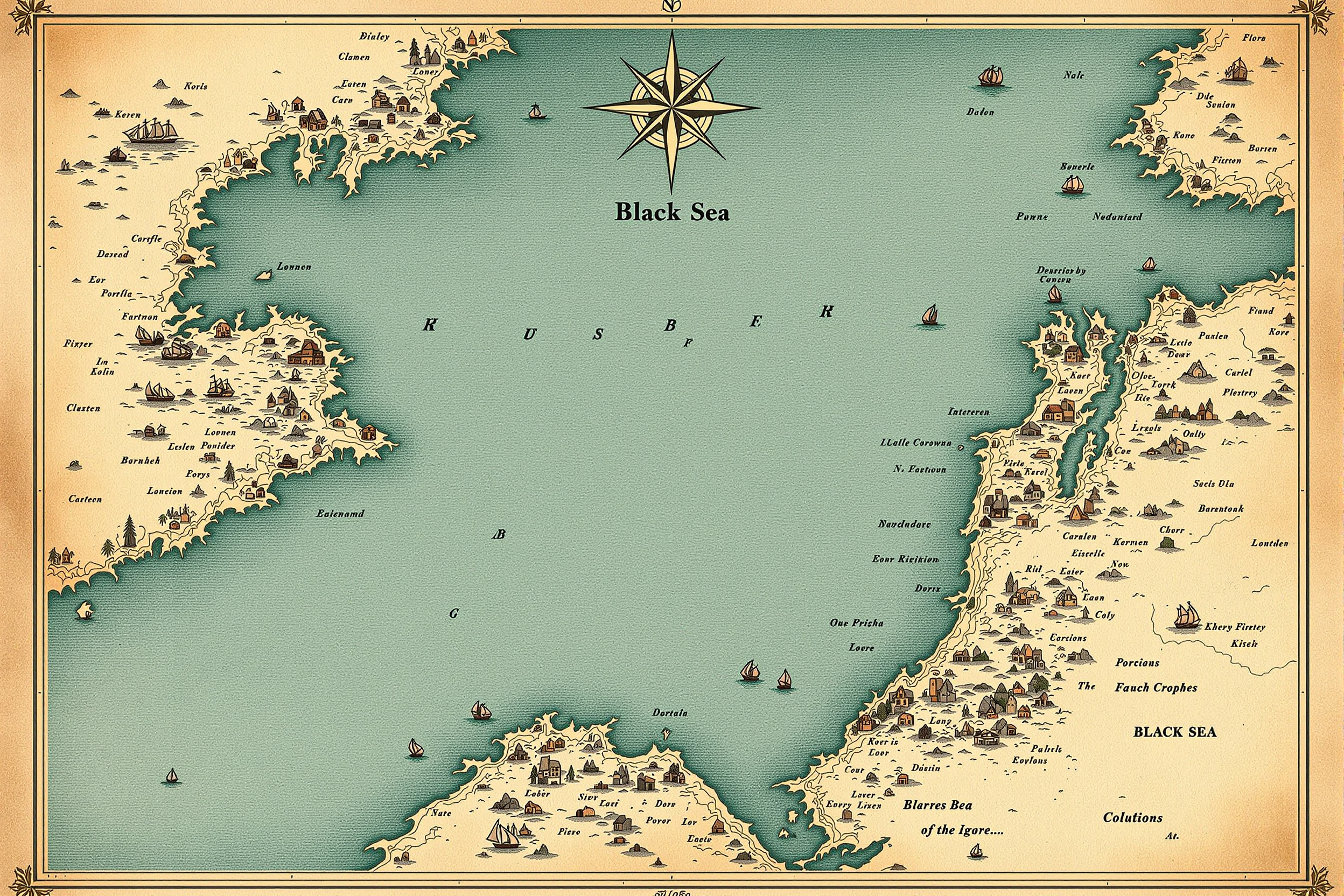
From its Odessa beginnings the Club expanded around the whole rim of the sea. Ukrainian and Russian ports were joined by Romanian Constanta and Galati, Bulgarian Varna and Bourgas, Turkish Trabzon, Samsun and Izmit, and Georgian Batumi and Poti, along with Mediterranean partners in Greece and Italy. By the 2000s the Club counted around twenty-seven members, a roll of cities that together represented a substantial share of the Black Sea's maritime population and trade. The full list of member cities is set out on its own page.
The assemblies
The rhythm of the Club was set by its assemblies, numbered in sequence and hosted in turn by member cities. These gatherings adopted resolutions, reviewed the work of the Club's board and directorate, and set the programme for the year ahead. Records point to a long series of such meetings, continuing into the mid-2010s; among the later ones was the twenty-fifth assembly, convened at Galati in Romania in May 2015. The assemblies page looks more closely at how these meetings worked.
Two decades of activity
For roughly twenty years the Club kept up a steady rhythm of work. Its assemblies met, its board gathered between them, and its cities exchanged visits, delegations and cultural programmes. News from the network in these years records board meetings in Romanian Galati, awards to municipal leaders, and the preparation of successive assembly agendas — the ordinary business of a functioning association. Member cities took turns to host, and the Club's roll of participants remained broadly stable even as individual mayors and administrations came and went, precisely because its offices were attached to cities rather than to particular people.
Dormancy
Like many regional networks, the Club depended on stable relations among its members. As political tensions returned to the Black Sea in the 2010s, the conditions that had made an open club of coastal cities possible became far harder to sustain, and the Club's public activity faded. This resource treats the Club as a historical body and documents it in the past tense, without speculating about any future revival. For the broader story of Black Sea regionalism, the Encyclopaedia Britannica entry on the Black Sea gives useful context.